
Staten Island City Directory Holdings
Staten Island historical-directory research begins with collections, not a claim that every year is online. The strongest verified local clue is an 1898 Staten Island census, residential, and business directory. Trow's Business and Residential Directory of the Borough of Richmond, City of New York is also a verified title. NYPL and the Staten Island Historical Society hold local directory and telephone-era material, but the captured sources do not list a complete run for either Trow or Polk. Treat an unlisted year as a gap to check in person, rather than filling it with a guess.
| Collection | Years | Where Held | Access |
|---|---|---|---|
| Staten Island census, residential, and business directory | 1898 confirmed | NYPL reference clue; Richmond NYGenWeb guide | Catalog and local research |
| Trow's Borough of Richmond directory | Title verified; full run unknown | NYPL references; SIHS microfilm may supplement | On-site research |
| Polk and telephone directories | Local runs exist; exact years unknown | NYPL and SIHS microfilm | On-site research |
| Richmond County Advance | 1886-1922 | NYPL historic newspapers | Digital historic-newspaper access |
| Staten Island Advance | Microfilm 1921-2018; index 1991-present | St. George Library Center | Microfilm and NewsBank access |
The historical volumes are especially helpful between census snapshots because an alphabetical listing can carry an address and occupation. They do not prove ownership or every person in a home. Pair a listing with a deed, map, or census before drawing a larger conclusion. Note: The local sources confirm holdings and key dates, but not a continuous printed-directory sequence.
St. George Directory Sources
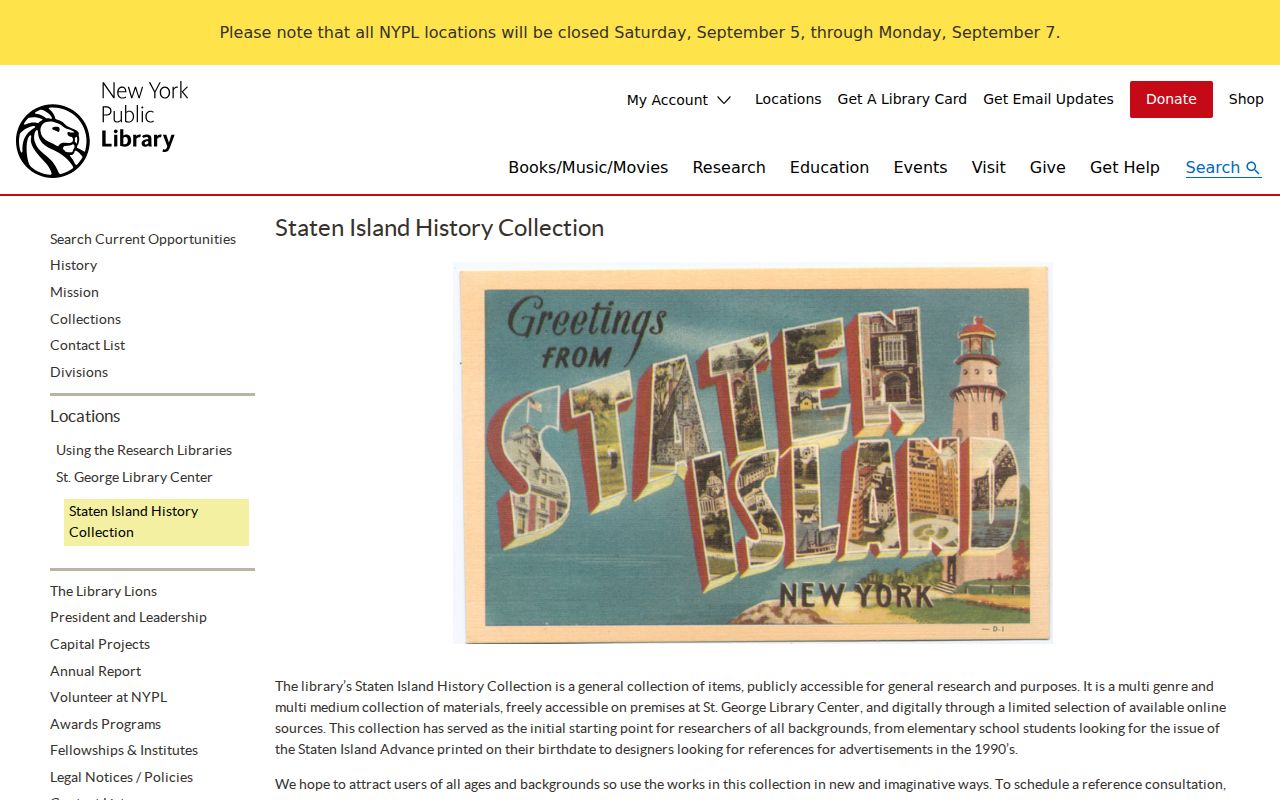
The Staten Island History Collection at NYPL's St. George Library Center is the main public-library stop for historical directories and their companions. Its on-site collection has more than 300 volumes from the final quarter of the nineteenth century to the present. It also brings together a 1907 street atlas, nineteenth-century atlases on microfilm, local newspapers, and databases that can fill in a name or address after a directory search. The NYPL description says a valid library card is required for History Collection digital resources.
NYPL documents the Staten Island History Collection as the source for this Staten Island archive reference image.
Bring the exact spelling, an address, nearby cross streets, and an estimated time range. That information lets staff point to a likely volume, atlas, newspaper reel, or database without treating a surname alone as conclusive.
The library also has Staten Island Advance microfilm for 1921-2018 and a NewsBank index for 1991-present. Those newspaper tools can explain a move, death, estate notice, or community event suggested by a historical entry.
Staten Island WPA Directory Leads
Historic Richmond Town offers a different kind of Staten Island historical-directory trail. The research library's Search Room has vertical files and 3x5 cards begun through the WPA Historical Records Survey in the early 1940s. Its “Vital Records of Staten Island Families” collection fills 47 drawers. The cards point researchers toward early wills, administrations, guardianships, deeds, mortgages, releases, newspaper notices, church records, tombstones, family Bibles, private papers, and published New York material.
Historic Richmond Town's research page is the source for this Staten Island archive image.

Friday research hours are listed as 1-4 p.m., with check-in at the Third County Courthouse and Visitor Center. Email or call before travel when directory reels, card drawers, or staff-assisted lookups are important to the search.
The Society also has microfilm of directories, newspapers, and federal census material, plus large maps and atlases. This is a reference-room method, not a one-box name search. Search surname variants, former town names, and institutions when an expected entry fails to appear.
Reading Staten Island City Directory Entries
A historical entry is compact, so copy its details exactly before interpreting it. The captured research did not include a digitized Trow or 1898 page, which means the volume's own abbreviation key controls. Common expected fields are useful search targets, not promises about every edition. Names may be abbreviated, misspelled, sorted under initials, or carried with a widow notation. An occupation or firm can help distinguish two people with the same name, but it is not proof of a later address.
| Name | Surname and given name or initials; spouse or widow notation may appear in parentheses. |
|---|---|
| Occupation | A trade, firm, or work affiliation that can separate similar names. |
| Address | House number and street, sometimes marked as home, residence, office, or business under the volume's key. |
| Cross-reference | An address-to-name entry in a reverse or criss-cross section when the volume includes one. |
| Abbreviation | A publisher-defined mark that must be checked against that volume's printed key. |
- Criss-cross directory
- The street-order part of a later directory, used to move from a house number to the listed occupant or business.
- Householder index
- An alphabetical index organized around a household name, which may not include every person at an address.
- Abbreviation key
- The publisher's list of shorthand marks, usually near the front of a volume; photograph or transcribe it before relying on a mark.
Copy the entry before expanding an abbreviation or standardizing a name. The page, edition, and printed notation preserve the evidence needed to check the interpretation later.
Staten Island Reverse Directory Searches
Use the alphabetical half of a historic directory for a name, then move to a reverse or criss-cross section when available. Start with the oldest accessible address listing, preserve the spelling and number as printed, and then compare the alphabetical entry for the same year. A different address in the two sections may flag a business location, a transcription issue, or a street-number change that needs map work.
Search in both directions. An address-first search can surface the listed household or business at a number. A surname-first search can reveal another address, a firm, or a widow notation. The 1907 atlas and later tax-map history help when an old street name does not fit a modern map. Do not turn a residence mark into an ownership finding without a separate land record.
Staten Island City Directory Family Trails
Follow one household through available directory years, then use the federal census as a wider snapshot. Directories can show annual address and occupation continuity. Census schedules can add age, birthplace, and other household members. Released federal schedules run through 1950 under the 72-year access rule. A one-year absence can reflect a missed volume, a move, illness, military service, death, a renumbered street, or an indexing difference.
- Begin with a current or known historical address and record alternate street names, house numbers, cross streets, and any BBL or legal-lot clue.
- Find the earliest available alphabetical or reverse listing and copy the name, address, occupation, and page.
- Check the same year in the other section of the volume, when it exists, to compare the household and street entry.
- Repeat across accessible years, keeping a dated table of spellings, addresses, and source pages.
- Pair the relevant directory year with a released federal census and then test unexplained changes against obituaries, probate, cemetery, or deed material.
Census Bureau decennial materials are the source for this Staten Island city directory research image.
A directory supplies a point in time. The census supplies a household snapshot. Neither should be read as a complete account of everyone who ever lived at the address.
Staten Island Maps Before Addresses
Maps explain why a modern address sometimes vanishes from a city directory search. NYPL holds a 1907 street atlas and nineteenth-century atlases on microfilm. The Library of Congress 1898 Staten Island Sanborn set has 104 sheets. Sanborn sheets show building footprint, construction material or use, lots, streets, and nearby context. They are not a roster of people and they do not establish ownership.
Compare the directory number with cross streets, lot shape, and older street labels before assuming the street stayed the same. The 1907 atlas, nineteenth-century atlas material, and 1898 Sanborn sheets form a useful sequence: road and parcel context, older landscape, and building context. Note: Map evidence can establish a place or structure at a date, but a named occupant needs a separate record.
Staten Island Directory Newspaper Context
Newspapers often close the gaps between historical directories. NYPL makes historic Staten Island newspapers available, including the Richmond County Advance for 1886-1922. The Staten Island Advance has microfilm for 1921-2018 and a NewsBank index from 1991 onward. Search both titles because the local newspaper name changed over time. Obituaries, marriage notices, legal notices, and community reports can help explain why a name appears, changes, or disappears.
Historic Richmond Town also provides free downloads of The Staten Island Historian, published from 1938 through 2016. Its articles cover family history, local industries, archaeology, and historic preservation. OCR can miss initials and unusual surnames, so inspect page images and try maiden names, married names, alternate spellings, and neighborhood clues. The New York State Historic Newspapers search is another institutional route for digitized local material.
Staten Island Directory Place Names
Staten Island is coextensive with Richmond County, but historical sources may say Borough of Richmond, Richmond Town, a village name, or a neighborhood instead of the current borough label. A directory, deed, atlas, or newspaper can use the older wording. Keep the exact street, former town or village label, cross street, BBL, and ZIP in research notes. Those terms make it easier to bridge a printed directory to a modern parcel or map.
When a household requires later address-keyed work, the Staten Island street directory provides the current parcel and street record path. Historical collection work remains strongest when each name, spelling, map reference, and source page is recorded in its own dated entry.